

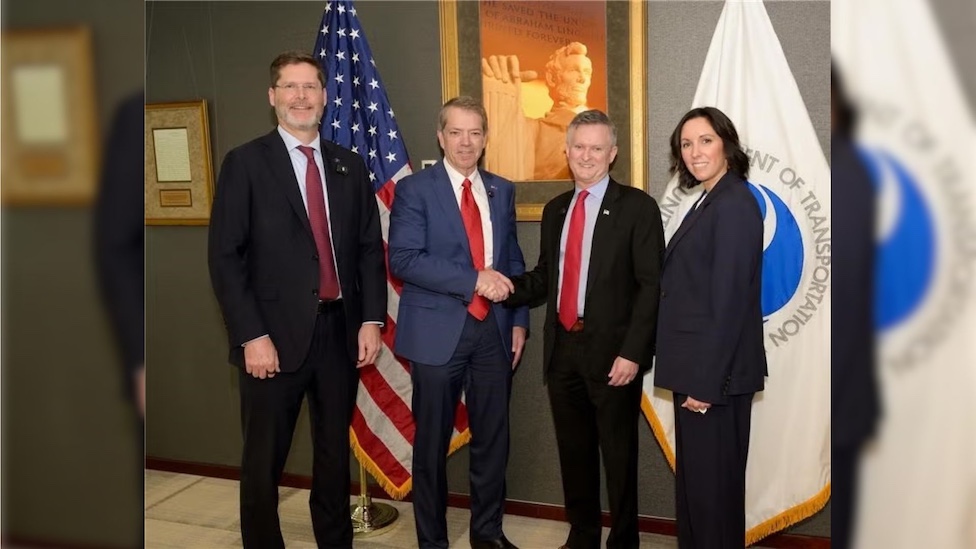
Lincoln, Nebraska – Jim Pillen and Sean P. Duffy announced a new agreement between the State of Nebraska and the Federal Highway Administration that is expected to accelerate transportation projects and streamline environmental reviews. The agreement allows Nebraska to assume responsibilities under the National Environmental Policy Act, commonly known as NEPA, giving the Nebraska Department of Transportation greater authority to manage environmental reviews and project approvals.
State and federal leaders said the move will cut delays, reduce costs, and allow major infrastructure projects to move forward more quickly.
“President Trump and Secretary Duffy are making great efforts to empower states by allowing decisions to be made at the local level — cutting through layers of over-the-top, environmental regulation,” Gov. Pillen said. “For decades, bureaucrats have delayed or blocked critical infrastructure projects. But today, the Nebraska Department of Transportation can streamline government, accelerate timelines, and increase affordability as we continue to build our state’s future. This agreement reflects our partnership up and down the Trump Administration as we continue to deliver results for Nebraskans.”
Secretary Duffy emphasized the agreement’s national implications.
“Nebraska is building again thanks to President Trump,” he said. “Today’s agreement removes unnecessary federal red tape — ensuring more major infrastructure projects are built on time and on budget. I hope to see other states follow Nebraska’s lead so we can get shovels in the ground sooner and continue delivering results for the American people.”
FHWA Administrator Sean McMaster said shifting responsibilities to the state will speed progress on road and highway improvements.
“Burdensome reviews and approvals by Washington have slowed progress on road and highway improvements in Nebraska and across the country,” McMaster said. “Now NDOT, the agency that knows Nebraska’s transportation needs best, will be able to take on additional NEPA responsibilities and ensure projects like the Lincoln East Beltway are completed in less time and at less cost to taxpayers.”
Vicki Kramer, director of NDOT, said Nebraska achieved full NEPA assignment in less than a year thanks to strong collaboration with federal partners.
“Our experience delivering categorical exclusions coupled with a strong partnership with the Federal Highway Administration allowed Nebraska to achieve full Section 327 NEPA Assignment in less than a year,” Kramer said. “This milestone is a direct reflection of the Trump Administration’s intense focus on streamlining project delivery.”
What the Agreement Means
Under the Memorandum of Understanding, Nebraska will assume responsibility and liability for environmental reviews, including environmental assessments and environmental impact statements. The state first received limited NEPA authority for categorical exclusions in 2018. This new agreement expands that authority to full programmatic responsibility.
Officials say the change will give Nebraska greater flexibility to manage projects, shorten timelines, and reduce costs while maintaining environmental compliance.
Nebraska is now the third state to join this partnership model. Last summer, Secretary Duffy signed a renewed NEPA memorandum with Texas, and the FHWA administrator signed a NEPA assignment agreement with Maine just last month. With Nebraska’s participation, nine states now have full NEPA responsibility, and more are exploring the process.
Major Projects Expected to Benefit
Several major transportation initiatives are expected to benefit from the streamlined review process.
The Lincoln East Beltway project will complete the final segment of a beltway planned since the 1970s. The four-lane freeway will extend from the eastern end of the South Bypass and connect to Interstate 80 near Waverly.
The US-75 corridor study between Interstate 80 in Omaha and N-370 in Bellevue aims to improve approximately six miles of roadway. Planned improvements include pavement reconstruction, upgraded structures, enhanced safety features, and improvements to seven interchanges serving the south Omaha metro area and Offutt Air Force Base.
Another initiative, the Interstate 480 corridor study from Interstate 80 to Harney Street, seeks to improve mobility and safety in central Omaha by reducing congestion, collisions, and recurring operational problems.
The City of Beatrice will also benefit through the Court Street Access and Safety Transformation Project. The project will reroute US-136 one block south to Market Street, moving truck traffic away from downtown and allowing Court Street to be redeveloped into a more pedestrian-focused corridor. Officials also executed a $21 million grant agreement to advance the Beatrice project.
Streamlining Project Delivery
The NEPA Assignment Program allows states to assume federal environmental review responsibilities while receiving technical support from the FHWA. Officials say this model promotes efficiency while maintaining environmental standards.
With the new agreement in place, Nebraska leaders say they are positioned to move infrastructure projects forward more efficiently, improve safety and mobility, and strengthen the state’s transportation network for future growth.
By shifting decision-making closer to the communities impacted by transportation projects, state officials believe the agreement will help deliver critical improvements faster while ensuring accountability and responsible environmental stewardship.

